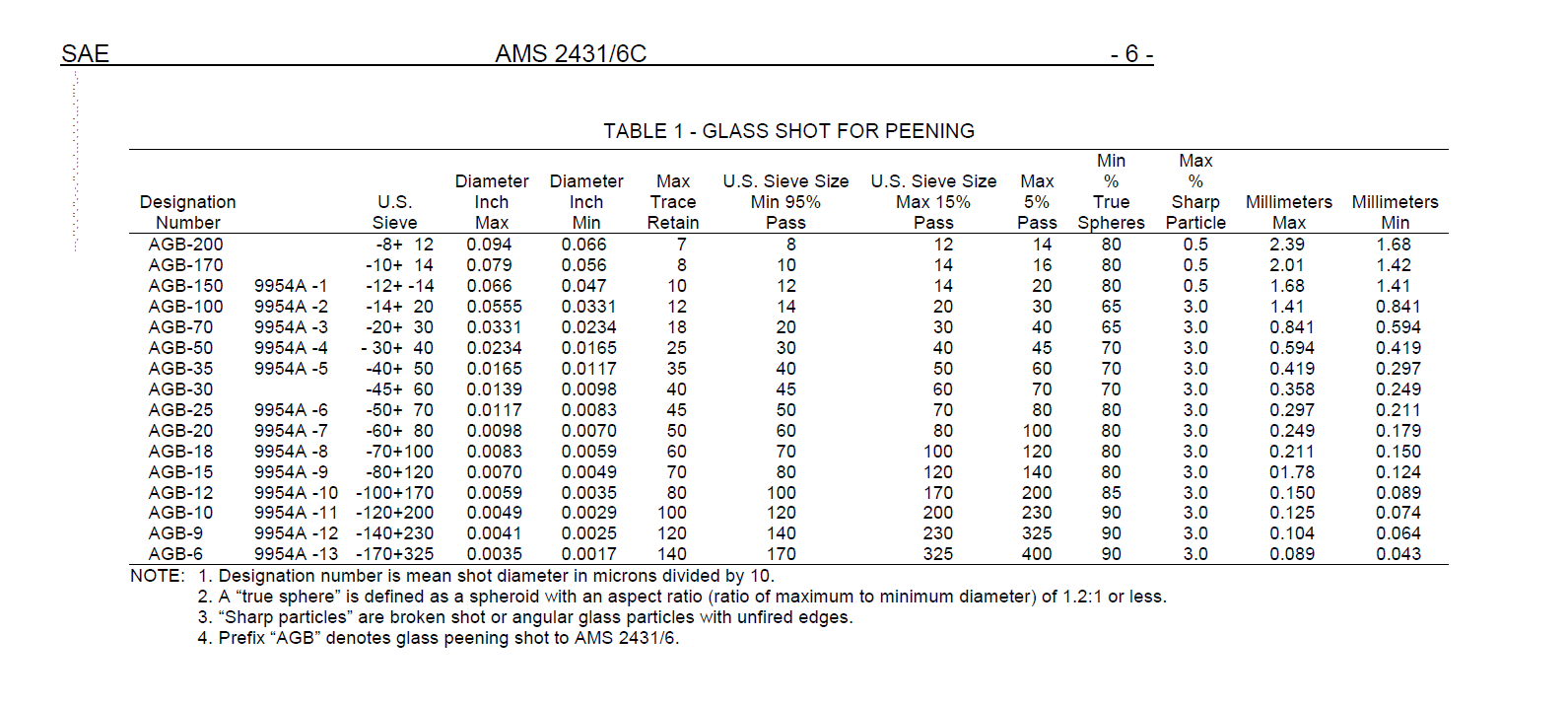
For AGB‑35 aerospace‑grade glass beads under SAE AMS 2431‑6 specification, the number “35” is an official size grade designation, rather than mesh number, micron reading, density value or hardness indicatorPotters In…. AGB stands for Aerospace Glass Bead, the unified product prefix for solid soda‑lime glass shot specially manufactured for aircraft‑industry shot‑peening treatment. Each numeral after AGB forms an independent sizing code, which corresponds to a fixed sieve particle‑size range defined in the aerospace material standard.
Specifically, AGB‑35 matches the US standard sieve fraction of 40‑50 mesh, with its particle‑diameter range from 300 μm to 425 μm (0.30 mm‑0.425 mm). This size coding system originates from the original specification of Potters Industries, the pioneer manufacturer of aerospace glass peening media, and has been widely adopted by global glass‑bead producers for cross‑reference. It is critical to distinguish AGB‑35 solid shot from hollow glass microspheres. On hollow‑glass‑bead products, figures such as 35 usually represent bulk‑density parameters, but this definition never applies to AGB series solid glass beads.
Apart from particle dimension, this grade code also locks in other mandatory physical requirements for production inspection. AGB‑35 glass beads are required to reach a minimum spherical percentage (roundness) of 80 %, while the content of sharp‑edged particles shall not exceed 0.5 % by weight. Its density is no less than 2.3 g/cm³, and Vickers hardness falls between 500 HV and 550 HV, suitable for peening aluminium, titanium and other high‑strength lightweight aerospace components without surface contamination.
Full‑series AGB grades follow the same coding rule, including AGB‑200, AGB‑170, AGB‑50, AGB‑35, AGB‑30, AGB‑25, AGB‑18, AGB‑15 and so on. Buyers in aerospace procurement directly use these grade numbers to place orders, so there is no need to convert them separately into mesh or micron data when drawing up technical agreements.